Independent
Measured by someone else
A university laboratory, using a standard method, on a sample we sent them. We report the number they measured and name the institution.
Limit: these are tests of the fabric, not of a body.
Free delivery on orders over €60
Evidence
Four measurements sit behind this product. Three were made by independent university laboratories. One is ours. Below is all of it: the methods, the numbers, the published research we rely on, and the things we have not proven.
University of Ljubljana
Where we tested it
−1.3 °C
Max measured vs cotton
99.99%
RF blocked by fabric, 2–6 GHz
4.3×
Air permeability vs cotton
How to read this page
It is an unusual thing to do, and it makes our own numbers look weaker. We do it anyway. In a category this full of promises, a number is only worth something if you know who measured it.
Independent
A university laboratory, using a standard method, on a sample we sent them. We report the number they measured and name the institution.
Limit: these are tests of the fabric, not of a body.
Our own
Our internal wear testing. Real conditions, small sample, no blinding, no peer review. Useful, and clearly not the same category of evidence.
Limit: not a clinical trial, and we never present it as one.
Published
Peer-reviewed work by other people, on temperature and on radiofrequency exposure generally. It explains why any of this is worth measuring.
Limit: none of it studies this product.
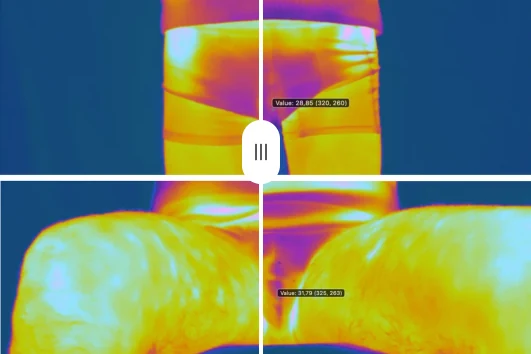
Regular
underwear
Majella
underwear
The premise
Testicles sit outside the body for a simple biological reason: sperm production requires a temperature 2–6 °C below core body temperature.
Modern daily habits (eight hours in an office chair, hot cars and synthetic underwear) trap heat and narrow this vital gap.
“Scrotal hyperthermia impairs sperm concentration and motility, with prolonged desk sitting increasing temperatures by up to 2.0 °C.”
Human Reproduction Update & Journal of Andrology
This biological fact isn't ours, nor is it controversial. What we set out to test is simple: can redesigned underwear restore that natural temperature gap, and by how much?
The modern environment
Phones stay in our pockets all day, right next to sensitive tissue. A growing and consistent body of research points to a link between radiofrequency electromagnetic fields (RF-EMF) and reduced semen quality.
“RF-EMF exposure from mobile phones is consistently associated with decreased sperm viability, motility, and increased oxidative stress.”
Environmental Research & Central European Journal of Urology
Radiation affects male reproductive tissue in two primary ways: it causes localised micro-thermal heating and triggers cellular stress, both of which impair optimal sperm production.
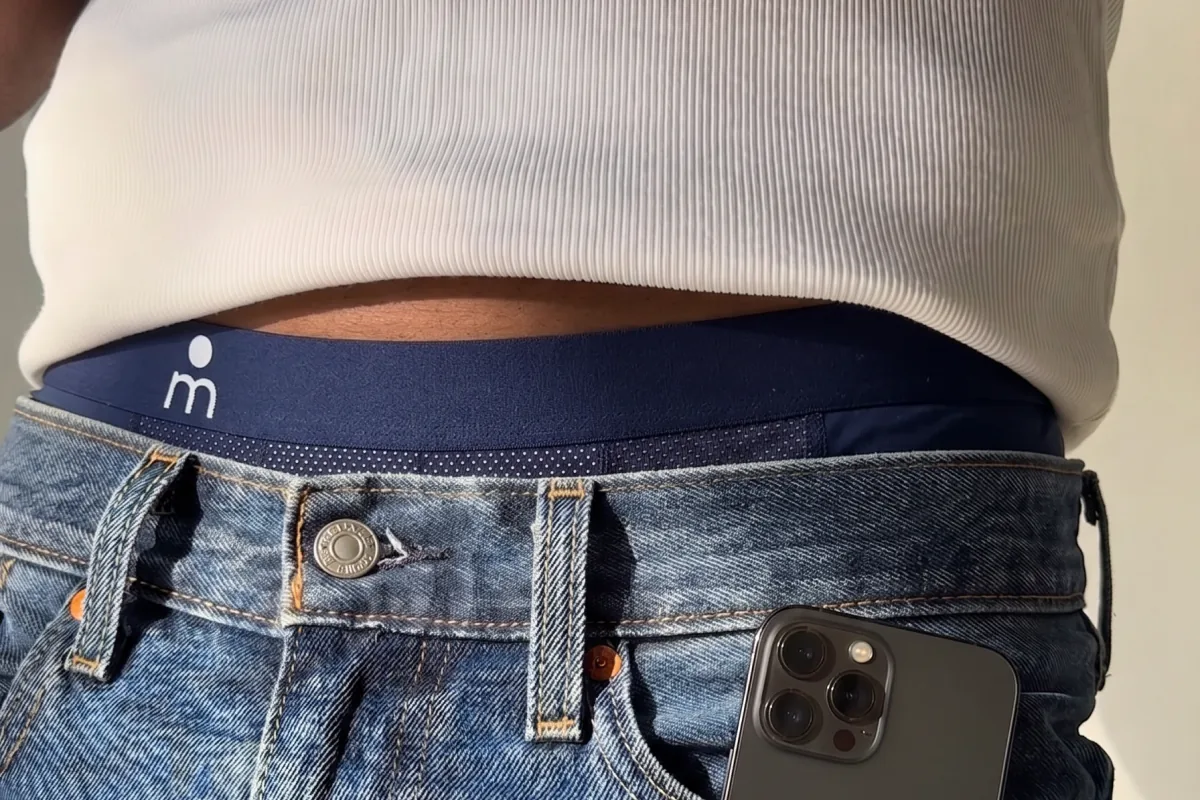
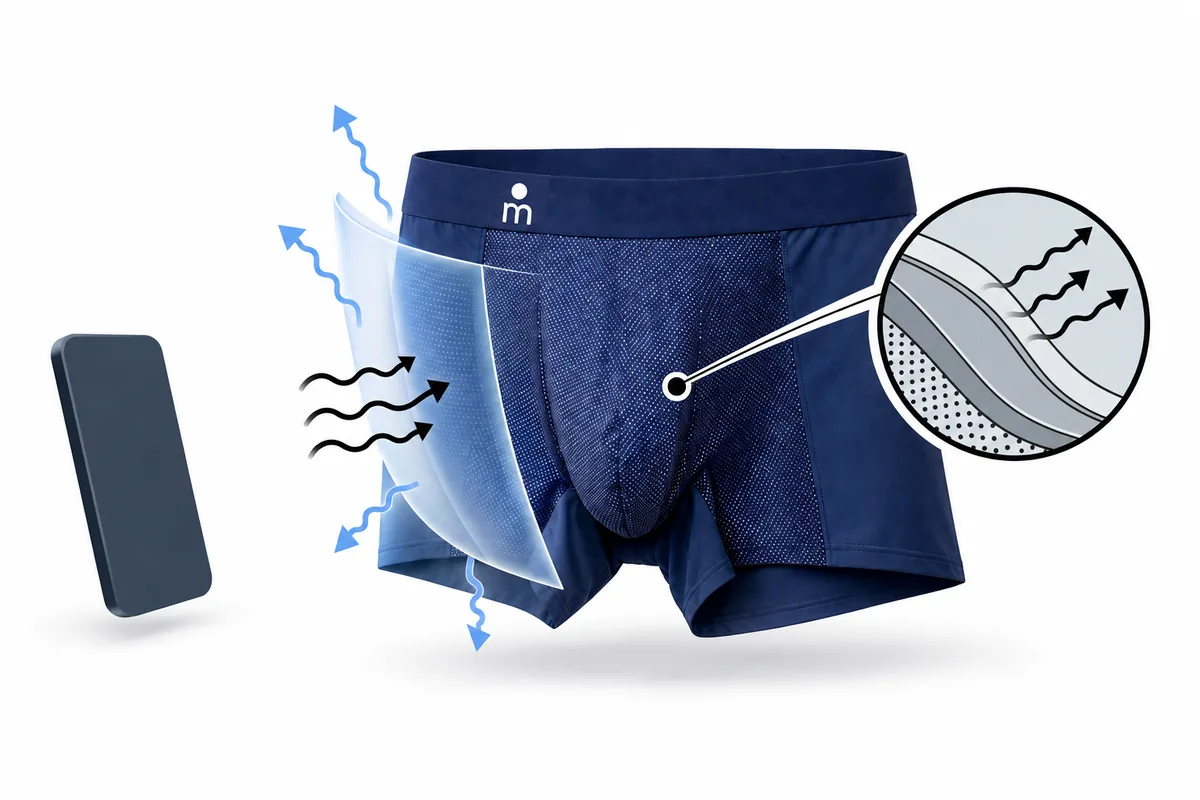
Because phones and Wi-Fi are now an unavoidable part of daily life, we built silver-fibre shielding directly into the fabric. In a lab test the fabric blocked up to 99.99% of RF radiation, forming a direct barrier where exposure is highest.
The three tests
Test 01 · Independent
Institution
Laboratory for Radiation and Optics, Faculty of Electrical Engineering, University of Ljubljana
Sample
Fabric from the shielding panel
Method
Transmission attenuation measured across the 2–6 GHz range, the bands used by mobile telephony and Wi-Fi
Result
Up to 99.99% of the RF energy passing through the fabric blocked
What it shows
The fabric attenuates radiofrequency energy in the tested range
What it does not show
Any health outcome. It is a materials test, on fabric, not on people.
Durability
Designed for long-term wear and frequent washing: the silver fibres are part of the structure, not a surface coating that washes out.
Test 02 · Independent
Institution
Faculty of Natural Sciences and Engineering, Department of Textiles, University of Ljubljana
Sample
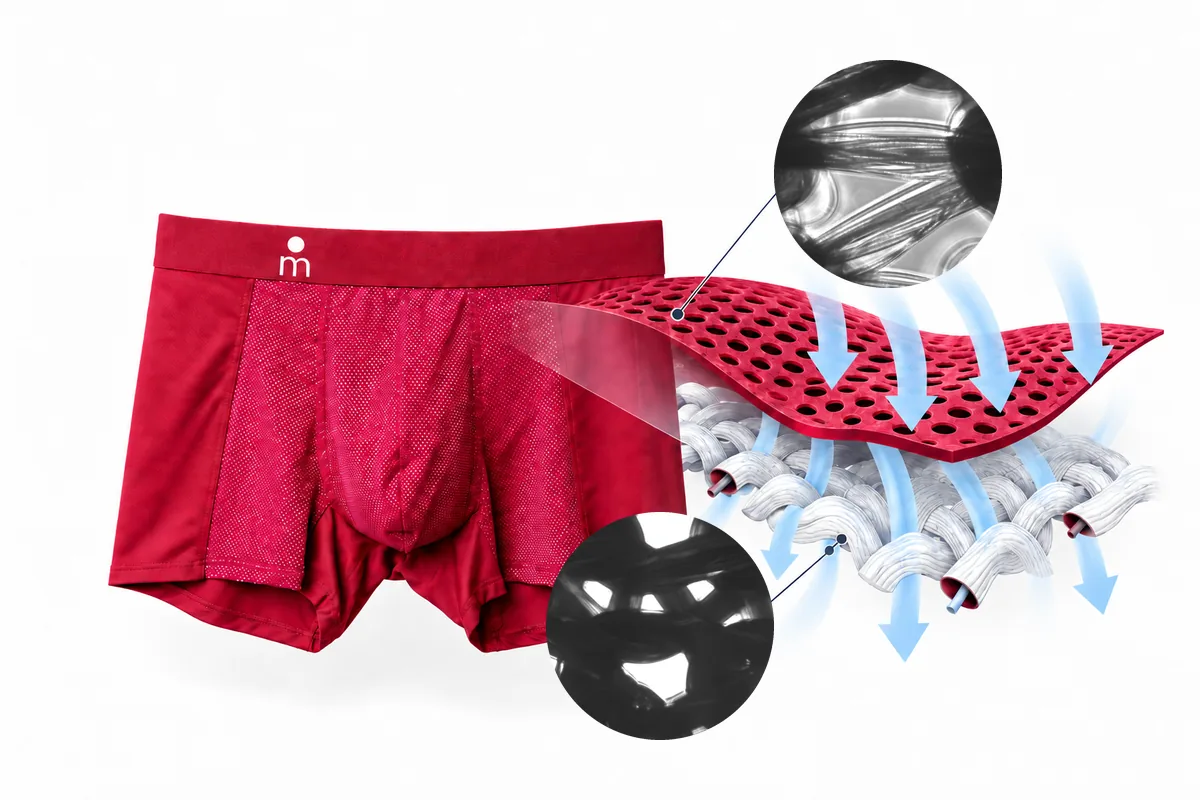
Majella knit, against a cotton control
Method
Standardised air permeability test
Result
Up to 4.3× the air permeability of cotton
Also observed
At 400× magnification the fibres are roughly five times thinner than a human hair
What it shows
Substantially more air moves through this fabric than through cotton
What it does not show
A specific temperature outcome on a body. Permeability is not the same measurement as cooling.
Test 03 · Our own
Who ran it
Us. Not a laboratory, not independent.
Duration
One month
Method
Paired wear testing with temperature probes during sedentary office work. Majella one day, cotton the next: same person, consecutive days, comparable clothing and weather, because that is the only way to make the comparison mean anything at this scale.
Average result
0.4 °C lower average daily temperature
Maximum result
1.3 °C lower on the day with the largest difference
Variability
Wide. The difference depends heavily on the day, the trousers, the weather and the person. We publish the range, not just the best numbers.
What it is not
A published clinical trial. Small sample, no blinding, no independent oversight, no peer review.
In preparation
We are preparing a study with the Faculty of Electrical Engineering that will use thermal imaging to measure temperature reduction under controlled conditions, on people. When it is published, we will link to it here, whatever it finds.
If the result is smaller than our own measurement, that number replaces ours on this page.
It will test
Scrotal temperature, Majella against regular underwear, under controlled conditions
It will not test
Direct fertility outcomes. That is a different kind of trial entirely.
Why not
Claiming a direct effect on fertility without dedicated, multi-year clinical trials would simply be dishonest.
What it will let us say
“Clinically tested”: specifically about temperature regulation. Nothing more.
How it works
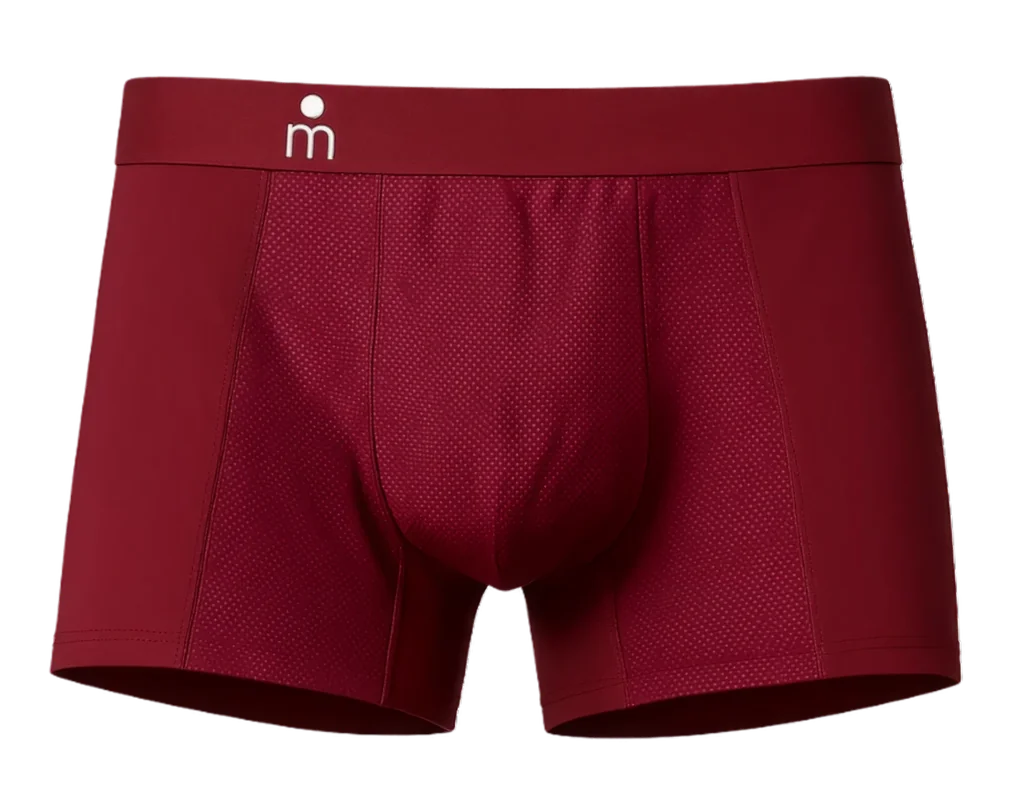
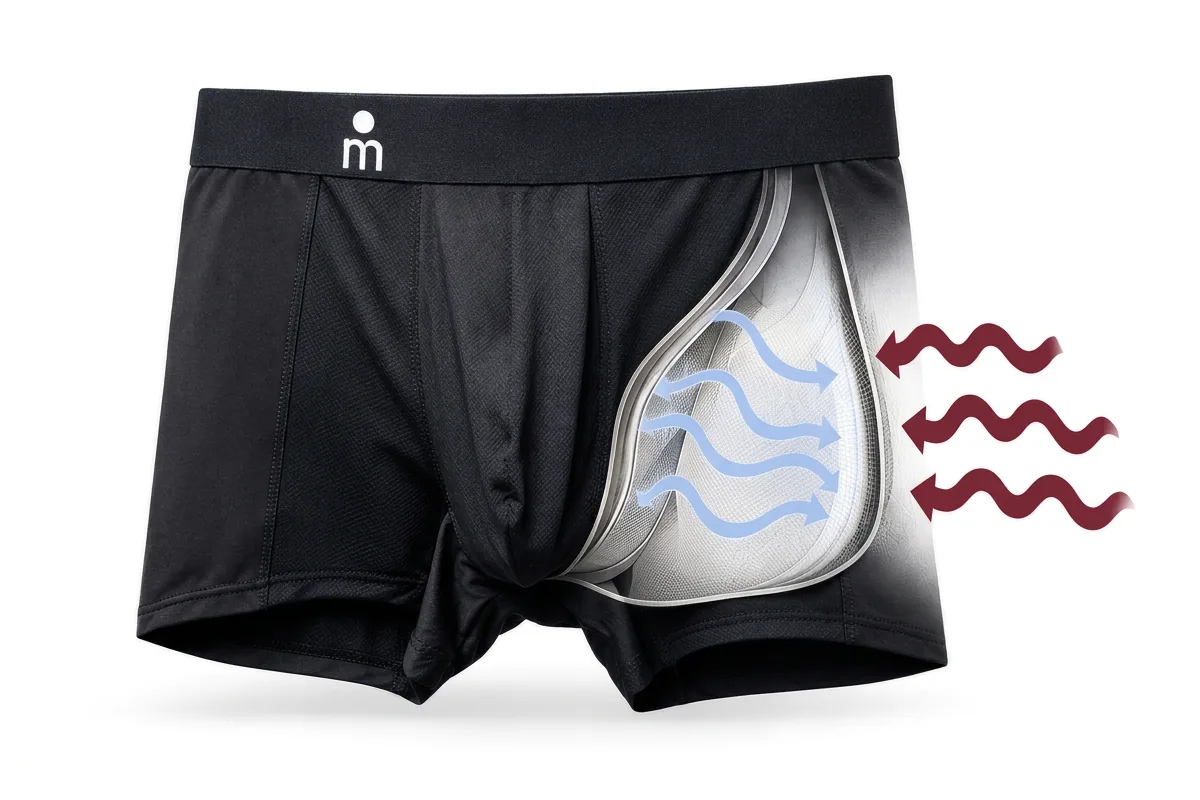
A wider 3D pouch keeps the testicles separated from the thighs and torso instead of pressing them flat against you. Air moves, and they don't heat up against your body.
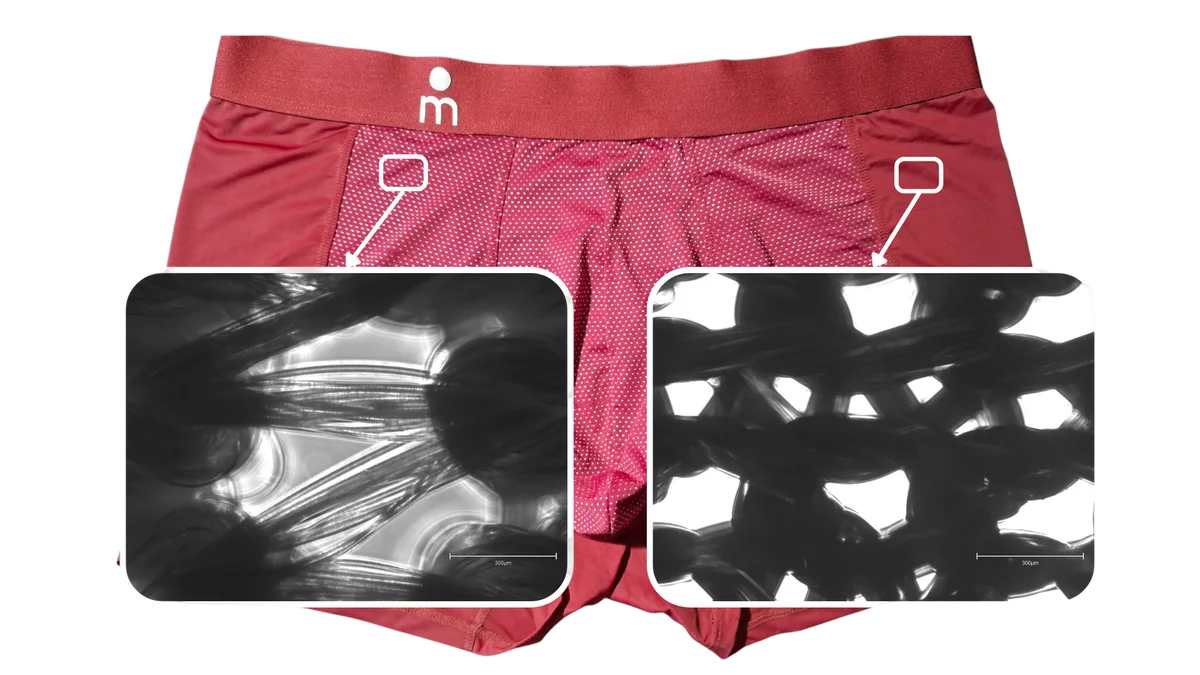
A silver-fibre knit with an elastane mesh panel. Cotton absorbs moisture and holds it against the skin; this knit moves it to the surface, where it evaporates.
Up to 4.3×
the air permeability of cotton, Faculty of Natural Sciences and Engineering, Department of Textiles, University of Ljubljana
References
Independent peer-reviewed studies on the impact of temperature and radiofrequency exposure on male reproductive health. Authors and year of publication are listed with each study.
1
Sperm production works best at roughly 2–6 °C below core body temperature.
On the optimal temperature for spermatogenesis and how the scrotum regulates testicular temperature.
Mieusset et al., 1995 · Zhu et al., 2022
2
Raised scrotal temperature is associated with changes in sperm concentration and motility.
On elevated scrotal temperature and sperm parameters across a range of exposure contexts.
Gao et al., 2022 · De Toni et al., 2023
3
Measured scrotal temperature is associated with sperm concentration.
Observational work on scrotal temperature and sperm concentration.
Hjollund et al., 2002
4
Elevated temperature affects germ cells, including through oxidative stress and apoptosis.
On the cellular mechanisms of heat-induced damage.
Durairajanayagam et al., 2021
5
The link between RF radiation and semen quality is not yet settled.
Reviews and primary studies on radiofrequency electromagnetic field (RF-EMF) exposure and semen parameters. Methods and quality vary considerably.
Kesari et al., 2018 · Darvish et al., 2020
6
After prolonged exposure to mobile phone radiation, fewer sperm were normally motile.
In vitro work on prolonged mobile phone exposure and sperm motility.
Gorpinchenko et al., 2014
Limits
Nobody has shown this for any underwear. Showing it would require a controlled trial with fertility as the endpoint, and nobody has run one. We are not going to imply otherwise.
Permeability is measured on fabric in a laboratory; temperature is measured on a body in the real world. Related, not identical, which is why we report them separately.
It is a small internal study without blinding or peer review. It is the honest best we can show today, and a proper study is in preparation.
The shielding figure is a measured property of the fabric. The literature on RF exposure and semen quality is unsettled. The two should not be joined into a promise.
What we do stand behind: COOLER, MEASURED. SHIELDED, TESTED.
Everything else is the researchers' findings. We cite them; we don't claim them as ours.
Plain English
Spermatogenesis
The production of sperm. It runs on a cycle of roughly 63–74 days, which is why nothing in this area changes quickly.
Sperm motility
The proportion of sperm moving normally. One of the standard parameters in a semen analysis.
Radiofrequency (RF) radiation
The part of the electromagnetic spectrum used by mobile phones and Wi-Fi. We tested 2–6 GHz because that is what phones actually use.
Air permeability
How readily air passes through a fabric. Measured in a standardised test, against a cotton control.
Scrotal temperature
The temperature at the testicles, typically a few degrees below core body temperature. The variable everything on this page is about.
Sperm concentration
How many sperm are present per millilitre of semen. Another standard parameter.
Attenuation
How much a material reduces the energy passing through it. Our shielding figure is an attenuation measurement.
Thermoregulation
The body's management of its own temperature. The scrotum does this by moving the testicles closer to or further from the body.
FAQ
No, and we won't claim that. We measured temperature and radiation shielding. The research linking testicular temperature to semen parameters is other people's work and is about temperature in general, not this product. Sperm production runs on a cycle of roughly 63–74 days. If you and your partner are trying for a baby and it isn't happening, see a doctor.
On the fabric. The sample was fabric from the shielding panel, so it is a materials test, not a test on people.
In our own month-long paired wear test during sedentary office work: 0.4 °C lower on average, with a highest single-day difference of 1.3 °C. The spread is wide and depends on the day, the clothing and the person. That is our measurement, not a published study.
The difference depends heavily on the day, the trousers, the weather and the person. We would rather publish the range than the best number alone.
We are preparing a study with the Faculty of Electrical Engineering that will use thermal imaging to measure temperature reduction under controlled conditions, on people. When it is published, we will link to it here, whatever it finds.
Yes. Email us at info@majella-fertility.com and we will send them to you.
Disclaimer
Majella is underwear. IT IS NOT a medical device and not a treatment.
If you and your partner are trying to conceive, PLEASE SEE A DOCTOR. That is the single most important thing you can do, and it isn't buying underwear.